
23 Jan 25
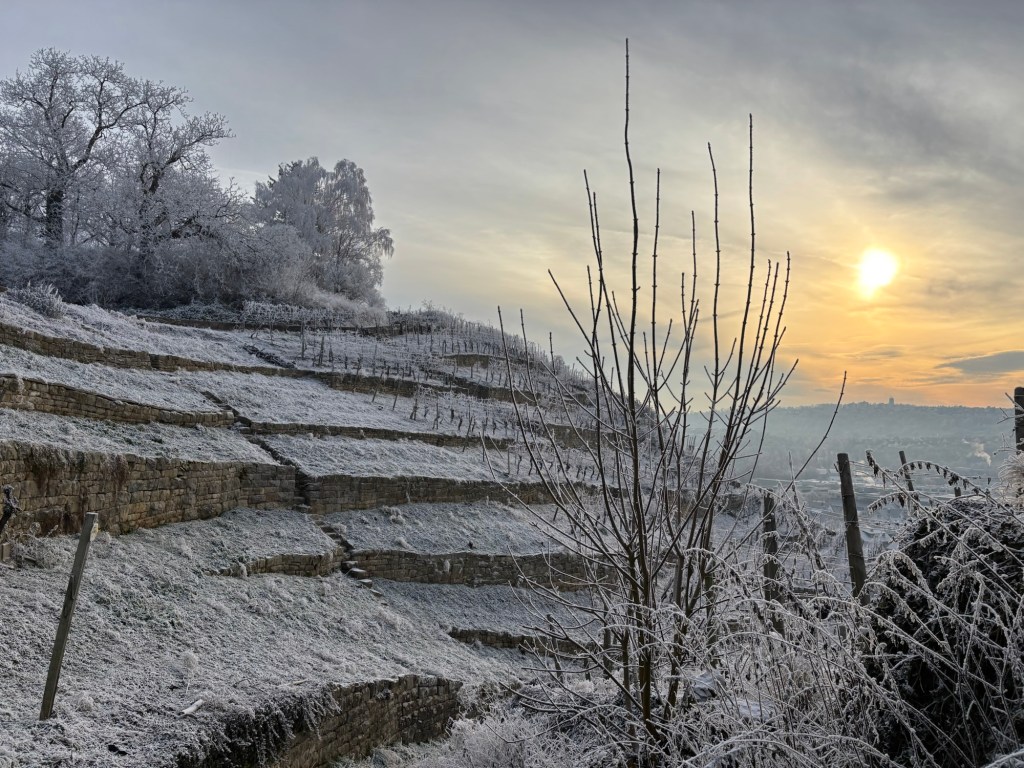
After days of it the fog finally broke and everything looked crystalline or coated in confectioners’ sugar, flocked. Before bed I read Anne Lamott’s memoir, the scene of her with her dad that day at the beach exploring the tide pools before they learned he had brain cancer. In just a page or two she traced the arc of his decline, his last two years, how it began when they got the CAT scan results that afternoon. I could picture me with our kids on the rocky Washington coast, those same shallow pools, how everything is more vivid on a day like that. How something so painful and personal for her became a thing of beauty in her treatment of it.
Each day I took the Himmelsleiter to the ridge with fruit tree farms and vineyards and small stone huts for as far as you could see, then curled back along the small roads to the adjacent town, almost a two-hour loop. The snow/frost clung thick to the power lines high above me and broke off in bits that floated to the ground. The visual effect of the frost on the lines was like a pipe cleaner, the symmetrical way the little frost spindles branched out on either side. I dodged some and listened for the soft poof sound it made when they hit the ground.
Somewhere a dog or chicken crowing against the hum of the power lines, the swoosh of traffic, sometimes church bells. I was so far away. Every day I took the same walk and every day when mom’s lodger Laszlo came home he’d pause in the doorway by our sitting room and ask so what did you do today, nothing? And there was very little to report. But on my walks it was a whole world of exploration, a micro world, like a scene inside a snow globe or one of those shallow tide pools like Anne Lamott described. I didn’t have any responsibilities to speak of and for a time could just drift and dream. Being in a foreign country that was so familiar was strange: I toggled between feeling at home and feeling removed.
I kept going between the past and present. Sitting in the dark in the morning by the electric candle arch waiting for the neighbor to turn on theirs. Jotting down notes on my phone as I walked along the farms. Memory-making compels you to live in the present so you know what to remember. The past takes everything else.
Share this:

Categories: Creative Nonfiction, Memoir, Travelogues
 Bill Pearse
So lovely.
LikeLiked by 1 person
Thanks my friend and appreciate you reading!
LikeLiked by 1 person
I remember how quiet it was, that winter in Mainz where the snow lay deep. Like the world has donned ear muffs. There’s something of that in this quiet, melancholy piece.
Thanks Bill.
Super photo, too.
LikeLiked by 2 people
The new iPhone camera makes anyone look like an Ansel Adams. The detail of the frost on those bare tree limbs was so lovely. Glad you could have a look at my camera roll and reflect on your time here too, Bruce. Enjoy your evening!
LikeLiked by 2 people
Marvelous, to have nothing to report yet to have been completely absorbed.
LikeLiked by 2 people
That’s so true DD! I like that paradox for sure. Thanks for reading, hope your evening is cool and calming.
LikeLiked by 2 people
Cooking Bill – red cabbage that’s as tough as can be, for now.
LikeLiked by 3 people
Great description of the snow on power lines. Nice photo too. And your thoughts on memory making—true!
LikeLiked by 2 people
Hey thank you Audrey! Glad you liked that pipe cleaner image, was a lot of why I wrote that! Have a good rest of your week.
LikeLiked by 2 people
The comparison between the tide pools and the way you felt on your walks reminded me of another poet who saw “the world in a grain of sand”. Being conscious really makes a difference.
LikeLiked by 2 people
Thank you Christopher! Perspective is so funny and important like that, can be everything right? Be well. Thanks for reading!
LikeLiked by 2 people