

Thoracolumbar Fascia, source: Wikipedia
It’s hard to know the theme before you start writing. For me, theme emerges over time. It’s as though you know the theme sub-consciously, but need to go through an exercise requiring time and effort before it’s fully realized. I have never gone through “rolfing,” but it feels like I am breaking down bound-up ideas in a similar way, by writing every day.
I’m finding pieces of the puzzle, but can’t fit them together because I don’t know what the whole thing looks like yet, I don’t know the edges.
I’ve read a handful of writers talk about their method:
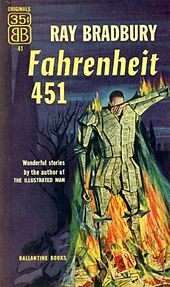
Cover of Fahrenheit 451, 1953. Source: Wikipedia
Stephen King has said that he doesn’t necessarily know the outcome of the story; he lets his characters lead him to the end. Ray Bradbury suggested that if you know the title, you know the story. Screenwriter lecturer Robert McKee insists that if you don’t know the ending, you don’t have a story. J.K. Rowling likely knew the end – Poe worked backwards, too.
I love the themes in Joyce and Shakespeare. Shakespeare leaned on imagery, to repeat his themes throughout and make damn sure his audience got it, since many of them were illiterate and only understood one third of the dialogue.
We dream in metaphor, which tells me our brains naturally work that way, on some level.
I am trying to learn how to see in the dark, find what’s buried in the cave, break down the bound-up fascia. It makes me feel sore, in a good way.
Share this:

Categories: Errata
 Bill Pearse
love this post (fascia and the subconscious in one breath!)m x
Date: Fri, 18 Jan 2013 14:01:17 +0000 To: mlevitin47@hotmail.com
LikeLike
Hi! Thanks for reading! Now get some sleep! – Bill
LikeLike
You may be on to something here. : ) I think all the time about the beginning, middle and the end of a story (blog) and how I want to write to be relevant. Good Post!
LikeLike
Thanks Alesia! It’s all a crap-shoot. Have a good time with it. Enjoy the rest of your night! – Bill
LikeLike